In partnership with

Today's Brief
A co-responder team that has handled 20,000 calls, and why people call it back years later
Louisville psychologists watch crisis calls live on bodycam, and Ulster County sends a deputy and a peer to overdose calls
Crisis funding in Philadelphia and New York due November 16 to December 16, and co-responder jobs paying up to $124K
Tacoma votes this month on a budget that eliminates its HOPE crisis team
Total read time: 4 minutes
Real Impact
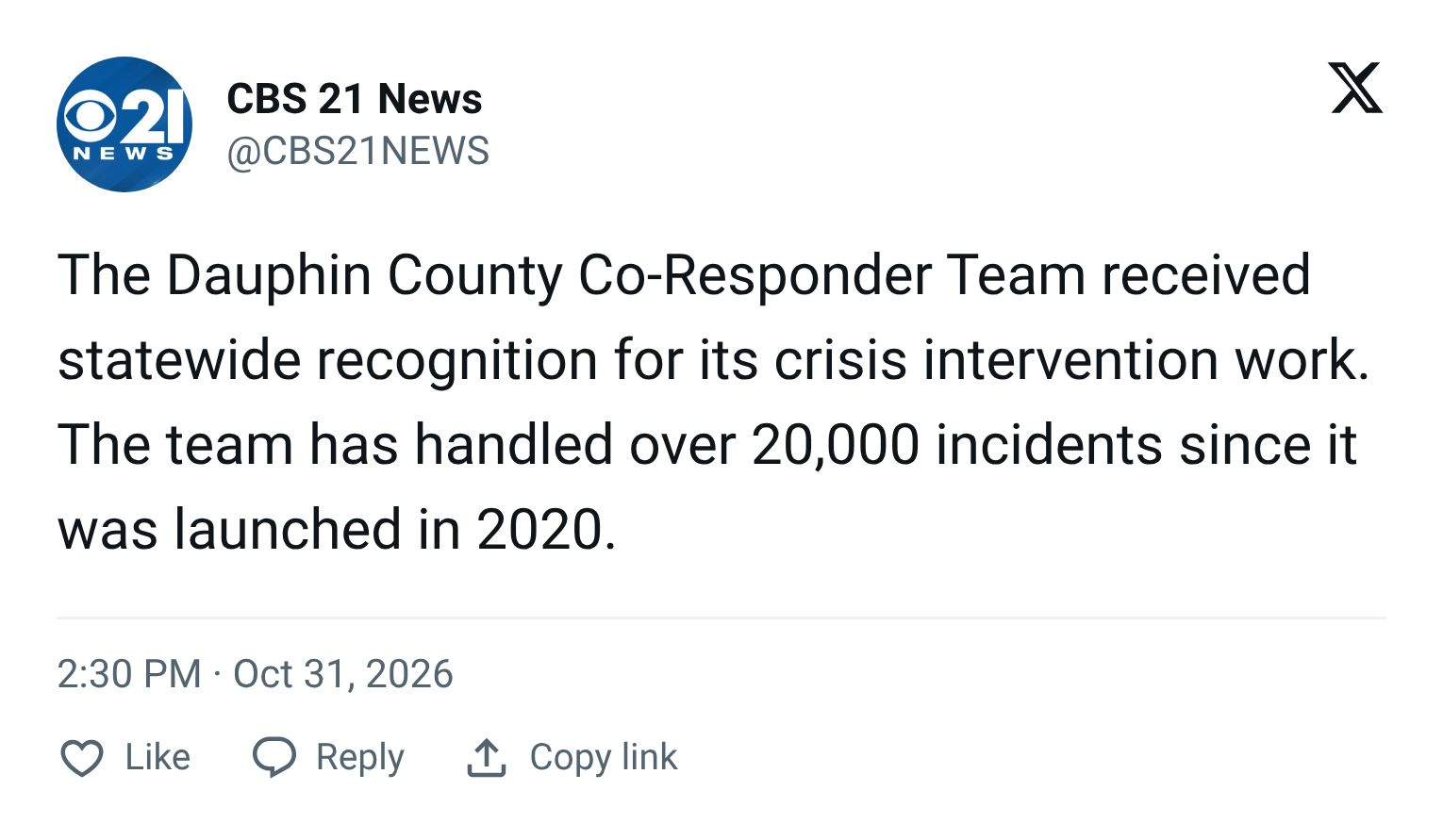
Devon Chianos is deputy chief co-responder on the Dauphin County Co-Responder Team, a 10-person unit embedded with eight police departments around Harrisburg, Pennsylvania. The team rides along on crisis calls to de-escalate and then connects people to help for mental health, substance use, aging, hunger and homelessness. Chianos says many of the people they meet reach back out on their own, sometimes years after the first call.
On October 27 the team was named Co-Responder Program of the Year at Pennsylvania's statewide CIT conference in Hershey, after handling more than 20,000 incidents since it launched in 2020. Pennsylvania now has CIT programs in 45 of its 67 counties, and the state's new CIT technical assistance center took more than 100 training requests in its first year. The full story covers why people keep coming back to the team and what the state is offering counties that want to build one.
Sponsored by:


Pitkin County proved your response can be more:
Coordinated: mental health clinicians and law enforcement on the same call, the same page, the same platform
Connected: patient data flowing securely across EMS, behavioral health, hospitals, and social services in real time
Compliant: HIPAA, 42CFR, and CJIS embedded, so sharing sensitive data never means cutting corners
Effective: 68% successful follow-up rate and 27% behavioral health enrollment after PACT team outreach
Efficient: 1 in 5 calls diverted to community support, getting officers back in the field faster
Affordable: fewer unnecessary incarcerations, fewer ER visits, millions saved
That's what happens when your community runs on Julota.
Program Upgrades
Who Else Is on the Call
LMPD officers have answered more than 2,500 crisis calls this year, and two mental health calls ended in fatal police shootings. Advanced Crisis Team officers now stream their bodycam to forensic psychologists mid-call, and the full story covers how that advice gets to an officer who is still talking to the person in front of them.
Sheriff Juan Figueroa's ORACLE program has referred 449 people to treatment and trained 190 officers in CIT, while nonfatal overdoses rose from 154 to 413 over three years. Figueroa's write-up explains how the pairing works and how he got all 15 local police departments to sign on.

Most AI newsletters get skimmed, then archived. TLDR AI is the one worth opening. It's a free daily email curated by engineers from OpenAI, Adobe, and Google DeepMind. They read everything, then send the model releases, research, and tools that actually matter. It’s a 5-minute read, delivered every weekday morning.
Resources
Funding Watch
Philadelphia DBHIDS: Mobile Crisis Services. The city's behavioral health department wants a provider that already runs Community Mobile Crisis Response Teams to deliver mobile crisis services in its adult crisis system. Proposals are due November 16.
Tompkins County, NY: Housing Solutions and Intensive Supports. A four-year contract for one nonprofit to run transitional housing and wraparound services for people whose substance use leads to frequent crisis calls or police contact. Proposals are due November 17.
New York State OMH: Safe Options Support Overnight Teams. One award to run three overnight outreach teams in Manhattan, Brooklyn, the Bronx and Queens, working streets, subway stations and emergency rooms after other services close. Applications are due December 16.
Just funded: Newark, NJ accepted $727,087 from SAMHSA for year four of a $2.9 million project to strengthen its co-responder teams.
On the Calendar
Co-Response Intensive Training, William James College, Holyoke, MA, November 16 to 20. A five-day training for co-responders and officers, with more sessions in February and May.
Missouri CIT Conference, Osage Beach, April 8 to 9, 2027.
NatCon 2027, New Orleans, April 11 to 14, 2027.
Now Hiring
Community Services Crisis Intervention Clinician, City of Denton, TX. $77,646 to $124,238. Closes November 14.
CRT Clinician, Community Response Team, Douglas County, Lone Tree, CO. $68,953 to $103,429. Closes November 30.
Crisis Clinician, Night Shift, Benton County, Corvallis, OR. $69,716 to $110,215. Closes November 15.
Crisis Intervention Specialist, HART, Harris County, Houston, TX. $27.00 an hour. Closes November 20.
Under Pressure
The fire department's HOPE Team, which sends a nurse and a mental health professional to behavioral health calls, was built with federal ARPA money and has shrunk from 10 employees to five filled positions. Keeping it at full strength would cost about $4 million over the next two years, and the council expects to adopt the budget in mid-November. If your program also launched on one-time federal money, this is the budget fight to watch.